

Aerial fire fighting
HeliAir Sweden carries out aerial fire fighting across the whole of Sweden. We hold the framework agreement with the Swedish Civil Defence and Resilience Agency (MCF) for the national helicopter standby against forest and land fires.
That standby rests on a fleet of more than 30 helicopters, 22 of our own fire buckets of 1,000–1,750 litres, and a mobile organisation of tankers and line stations that travels out to the incident area with them. HeliAir Sweden has participated in a large number of fire fighting operations throughout the years.
In Sweden, we are by far the helicopter operator who has flown the highest number of hours fighting fires, and we have a high performance organisation trained and tested in aerial fire fighting. Our capacity for this is unsurpassed in Sweden today.

Contracting authority
Framework agreement with MCF for aerial fire fighting nationwide
The national helicopter standby for fighting forest and land fires is coordinated by the Swedish Civil Defence and Resilience Agency, MCF (formerly MSB). HeliAir Sweden holds the framework agreement for that service and delivers it across the whole country.
A framework agreement is the outcome of a public procurement, and it is a delivery undertaking: MCF calls off helicopters from us when the agency decides to put standby in place. Under the agreement, at least ten water-dropping helicopters are to be available during the forest fire season, in addition to one helicopter used for coordination when required.
It is MCF that decides where the helicopters are stationed and at what level of readiness. The basis is a combined assessment of fire risk, values at risk and resource requirements, and the agency can move helicopters between counties and raise or lower readiness during the season.
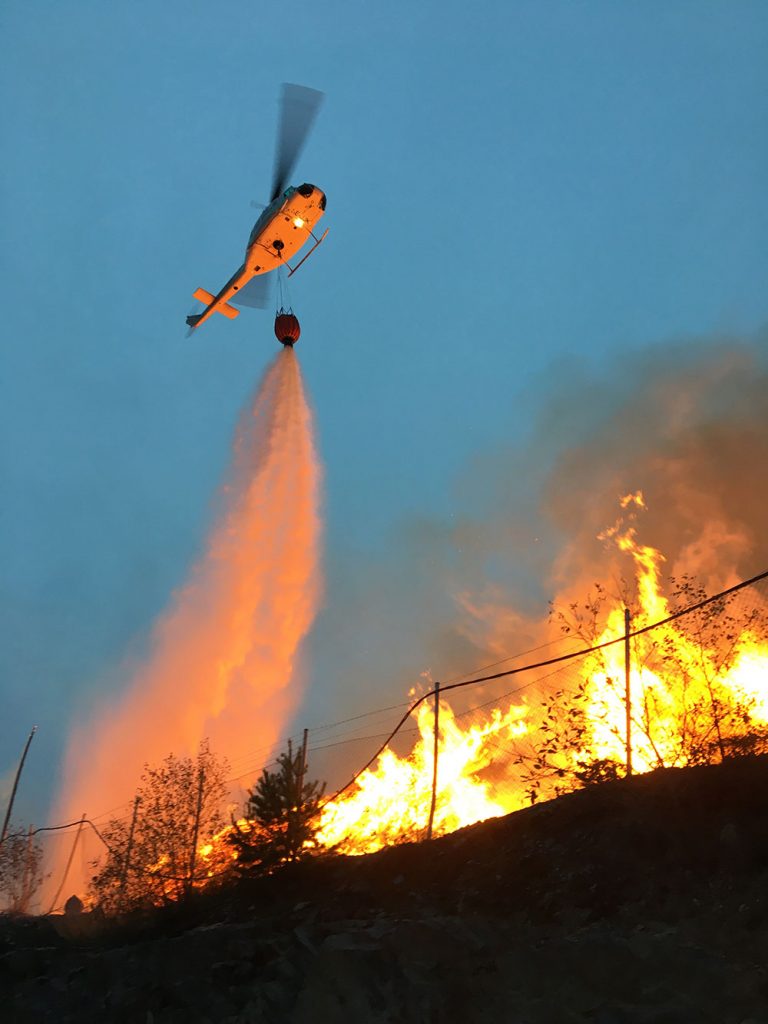
Water bombing against an active fire front. The bucket hangs on a line beneath the helicopter and is filled at the nearest water source.
Readiness
Operational readiness and response time
From our fleet of more than 30 helicopters, some 10 can be deployed for water bombing at short notice. During declared standby each helicopter is crewed by one pilot, and a response time applies – the anspänningstid, the time from the alarm to the latest moment the helicopter must lift off towards the fire. MCF normally sets 30 minutes, but 60 and 120 minutes occur in standby decisions depending on the fire risk.
With our main base in Västerås, our base in Lysekil on the west coast, and fuel and maintenance at a number of locations around the country, we operate across all of Sweden, from north to south. Once in place we can sustain an unbroken effort until the fire is extinguished, and call in more pilots and helicopters as the operation grows.
By a wide margin, we are the helicopter operator in Sweden that has delivered the most helicopter hours fighting fires. Those of our pilots who fly aerial fire fighting are certified for the task, and the pilot corps trains regularly on the elements it involves. Water bombing is often flown in turbulence, heat, poor visibility and dense smoke, with several aircraft in the same area. It is demanding flying, and recurrent training is what makes it possible to do safely.

Readiness
The same standby, different environments
While we are on standby we are dispatched through MCF whatever is burning. The response is the same – the same helicopters, the same crews and the same readiness time – whether it is a forest fire or a fire close to buildings.

Equipment
22 fire buckets of 1,000–1,750 litres
HeliAir Sweden owns 22 so-called Bambi Buckets, the collapsible fire buckets that hang on a line beneath the helicopter. Depending on the type of helicopter they hold from 1,000 up to 1,750 litres. Within the national helicopter standby, only buckets of 1,000 litres or more are used under the agreement.
The bucket is filled by lowering it into a lake, a watercourse or another water source close to the fire, and one metre of water depth is enough. That the water source can lie close to the fire is decisive: the combined suppression effect is determined less by how much each individual drop contains than by the turnaround time – how quickly the helicopter can collect fresh water and return.

Support
Mobile support: tankers and line stations
In order to deliver an unbroken effort, we place our own tankers with a capacity of 18 and 20 cubic metres at the incident area. In an operation that extends over time, refuelling then accounts for only about three minutes per hour flown.
Our technical organisation is approved by the Swedish Transport Agency for a number of support vehicles as mobile helicopter workshops, so-called Line Stations. Inspection, maintenance and repair of helicopters and other equipment is carried out on location with the same technical ability as at our main base. That operations, training and maintenance sit within one and the same organisation – AOC, EASA-approved ATO, CAMO and Part-145 – is what makes the mobile set-up possible.

Operation
From alarm to first water drop
At the start of an operation our operations department issues a Flight Order for the mission. It contains everything the pilot needs to know: the location of the incident area, contact persons, safety, and information about the fire. During the flight out to the incident area the collapsible bucket is carried inside the helicopter and rigged quickly on site on arrival, so that suppression can begin immediately.
At the same time as the helicopters lift from base, the mobile organisation is activated. Tankers and the mobile workshop begin the journey to the place where the set-up will be established, and more pilots join as the operation proceeds. Communication with the rescue command is by Rakel and telephone, and the helicopters are normally self-sufficient in fuel and supplies.
The helicopter does more than drop water
In addition to water bombing from helicopters, we can also assist with:
-
Personnel transport
Transport of personnel to and from the fire fighting areas
-
Equipment lift
Rapid movement of equipment and materials with a lifting capacity of up to 1,750 kg
-
Hose and pumps
Flying out hose caches and motor pumps to a water source to supply a containment line
-
Evacuation
Fast evacuation of people from areas threatened by fire
-
Reconnaissance and overview
An overview of the spread of the fire for the rescue command
-
Infrared camera
Heat-sensitive infrared cameras that see through smoke and record the GPS position in real time, so that resources can be directed to where new hotbeds flare up before the fire gets a stronghold
-
Live imagery
A number of technical solutions for live monitoring, filming and support to operational command

Requesting
How the rescue service requests helicopter support
In a forest fire it is the municipal rescue service that leads the operation. Helicopters within the national standby are not ordered from us but from MCF: an authorised decision-maker contacts the agency’s duty officer via SOS Alarm and completes the agency’s form requesting a reinforcement resource. MCF makes the decision to deploy, and we fly.
Outside the national standby you are welcome to contact us directly to discuss standby, exercises or an individual assignment.
Readiness in figures
- Framework agreement
- Swedish Civil Defence and Resilience Agency (MCF)
- Water-dropping helicopters on standby
- At least 10
- Response time from alarm
- 30, 60 or 120 minutes
- Fire buckets
- 22
- Volume per bucket
- 1,000–1,750 litres
- Water depth required
- At least 1 metre
- Own tankers at the incident area
- 18 and 20 cubic metres
- Helicopters in the fleet
- 34
- AOC Air operator certificate
- ATO EASA-approved flight school
- CAMO Continuing airworthiness
- Part-145 Approved maintenance organisation
Read more
-
Our helicopters
-
Our locations
-
Aerial work
-
Dry lease
We also offer dry lease of mission-equipped helicopters to other operators ahead of the fire season.
Frequently asked questions about aerial fire fighting
-
Depending on the type of helicopter, our helicopters drop between 1,000 and 1,750 litres per run. Within the national standby, only fire buckets of at least 1,000 litres are used. The combined effect is determined less by individual drops than by the turnaround time between the water source and the fire.
-
During standby a response time applies – the time within which the helicopter must lift off towards the fire after the alarm. MCF normally sets 30 minutes, but 60 and 120 minutes occur. The flight time to the incident area is added to that, and depends on where the helicopter is based.
-
At least one metre. That lets the helicopter use small lakes, tarns and watercourses close to the fire, whereas a scooping aircraft needs a considerably larger body of water.
-
They complement each other. A scooping aircraft of the Air Tractor AT-802F Fire Boss type drops about 3,000 litres at a time and covers large areas quickly, but needs a body of water around 100 metres wide, 3 metres deep and more than a kilometre long. The helicopter drops a smaller volume per run, but can work precisely, collect water from small pools next to the fire, and at the same time handle transport, reconnaissance and lifting tasks. MCF has agreements for both kinds of resource.
-
No. Within the national standby no additives are permitted in the water used for suppression, and the equipment is therefore assessed as free from PFAS chemicals.
-
No. Drones are excellent early in an operation for building an overview, but must be on the ground at least 20 minutes before helicopters or aircraft are flown into the area. Otherwise they are a flight safety risk.
Contact us about fire standby
Do you want to discuss aerial fire fighting, standby ahead of the season, or an individual assignment? Do not hesitate to contact us to find out more about our aerial fire fighting capabilities.